Read Aloud Lesson Ideas
Below are Read Alouds and Lesson ideas to use in your classroom I have found that having the books on video made it easier for all students to see. I put a child in charge of the stop and go to allow me to be more interactive with the students. In some demographics, at home libraries may not be as populated. Feel free to share this flyer with parents.
Use the Read Aloud Guiding Question document from nestaschool.com, as you interact with your community.
Use the Read Aloud Reflection Template to formatively access student detail awareness.
Porcupine Had a Fuzzy Sweater by Jody Jensen Schaffer
Retelling Story Comprehension Support:
I Am Enough by Grace Byers
Add a page to the book.
The Wolf the Duck & the Mouse by Mac Barnett
This is a story about a duck and mouse who get swallowed by a wolf, and then decide to live in his belly.
When a woeful mouse is swallowed by a wolf, he quickly learns he is not alone: a duck has already set up digs, and, boy, has that duck got it figured out! Turns out it’s pretty nice in there, with delicious food and elegant table settings, courtesy of the wolf’s unchecked gluttony. And there’s something even better: no more fear of being eaten by a wolf! In fact, life is pretty good, until a hunter shows up. . . . With a nod to traditional fables and a wink to the reader, the award-winning Mac Barnett and Jon Klassen offer a tale of cooperation and creative cuisine that is sure to go down easy.
Lesson Ideas:
Fable
Grade 2 (RL.2.2): Recount stories, including fables and folktales from diverse cultures, and determine their central message, lesson, or moral.
Grade 3 (RL.3.2): Recount stories, including fables, folktales, and myths from diverse cultures; determine the central message, lesson, or moral and explain how it is conveyed through key details in the text.
- Share with students the definition of a fable.
- a short, made-up story that teaches a life lesson or a moral. It usually features animals that talk and act like people.
- Discuss the read aloud.
- What characteristics or behaviors do the animals have that you have?
- How do their characteristics or behaviors help tell the story?
- What is the message or lesson?
- How does the text and illustrations convey this?
- What specific actions of the characters help you to learn and understand the lesson?
- Look at the Fable Reads website.
- Share a few fables with the class.
- Discuss the lessons.
- Use the discussion questions to help elicit responses.
- Ask how the characters help share the lesson.
- what are their characteristics, behaviors, attributes.
- Use the provided Fable quotes as daily social-emotional reflection or as a class behavior task.
- Town Mouse Country Mouse: “The beauty of life reveals itself when we learn to appreciate the little things.”
- At the end of the day wrap-up have students share something they appreciated, that was an action from someone else.
- Town Mouse Country Mouse: “The beauty of life reveals itself when we learn to appreciate the little things.”
- Create a class BB with fable themes and lessons. Have students add, as a class, to the third column with examples from individual or class actions.
- Share a few fables with the class.
Perseverance, Grit
” I may have been swallowed,” said the duck. “but I have no intention of being eaten.”
- Read the quote above to the students.
- Ask what they think it means.
- Give the definition of
- Perseverance: keeping on and not giving up when things get hard. It is the steady effort to reach a goal even when you face big problems, delays, or mistakes.
- Grit: having passion and long-term persistence for important goals. Having courage and mental toughness.
- Ask the students if the quote from Duck describes the attitudes and behaviors of perseverance and grit.
- Have them share examples in their life when this might apply.
- Have students stand up and repeat the quote.
- Encourage them to memorize it and say it in their head when needed.
Writing a Fable
Plus One by John Hare
When Agnes decides to host a tea party, she finds it hard to shake a most unlikely guest . . . and his even more unlikely friends
Community Building Activity
When Dave first knocks on the door, the author notes, “Agnes didn’t want this strange kid at her party.” Have a teacher guided discussion on this statement. Be aware of how questions are asked so that all social-emotional needs are your priority.
- Ask students to “Brain Think” (personal reflection, in your own head, nothing is said out loud) what they think the word strange means. Make sure students are all aware that nothing should be said out loud at this time.
- Share with the students the definition.
- Strange: unusual, unfamiliar, or foreign.
- unusual: not typical, uncommon, extraordinary
- unfamiliar: not well known
- foreign: from another place
- It describes things that are out of the ordinary, not known before, or hard to explain.
- Strange: unusual, unfamiliar, or foreign.
- Ask students if their brain think definition matched the actual definition?
- Elicit responses from students on how you can become familiar with something, make them ordinary, or find explanations for them.
- Ask how Agnes became familiar with David.
- Have a discussion with students on how we can see people in different ways after we become familiar with them.
- Elicit responses on how students can become familiar with their classmates.
- Interact in the Roll the Dice Activity.
- Presentation link.
- Roll the Dice Activity PDF
- Play M and M’s/Skittles icebreaker.
Re-usable Non-Candy Options (for classrooms or sugar-free groups)
pom poms, buttons, legos, in assorted colors
- Interact in the Roll the Dice Activity.
Have students write up an invitation for a party that they would like to have. Ask, “What information will you need to put on the invite”? Brainstorm ideas as a class. Encourage students to have fun and invite in creativity.
This may be a good time to announce to the class about any school policies on passing out personal party invites at school.
The Wonder You See by Joanna Gaines
Inspired by Joanna’s young son’s insistence to “look up!” and the shift to a slower perspective she enjoyed after having her last child, this book shares the delight of taking a friend by the hand, getting your boots muddy, and discovering the secrets just waiting to be uncovered. In The World Needs the Wonder You See, you and your kids will slow your pace, look closely, and find joy as you make discoveries together; join a diverse cast of children on a journey below leaves, amidst treetops, under ocean waves, through rabbits’ tunnels, and into the clouds; imagine hidden worlds in which ladybugs live in tiny cabins, snails journey through mushroom fields, and stars paint stories across the sky; and learn to notice the amazing beauty that children naturally see.
Family Engagement Activity
Print the Wonder Card on cardstock.
Recall that in the story the author asks us to share our wonders. “See how beautiful the world can be when we share what we find?”
Explain to the students that they will be taking home a Wonder Card to find a a wonder that they see. Point out that they will notice a wonder and then write about it on the back of the card. Depending on the age, parents can help in writing the wonder. Encourage students to draw their wonder as well.
Have students return their Wonder Cards to school when convenient for parents.
Consider displaying them on a Wonder Board.
Give by Jen Arena
With a gentle, poignant text by Jen Arena, and colorful, detailed illustrations by Rahele Jomepour Bell, this unforgettable story shows the power of simple acts of kindness and the potential to change other people’s days for the better.
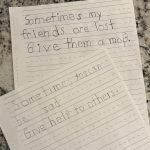
After reading the book, students were given a sentence stem to write their own “Give” response. Students wrote the response out to practice handwriting and grammar skills.
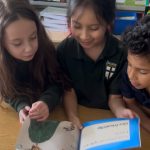
Students drew detailed pictures of their sentence STEM. These were added as images to a class book from storyjumper.com.
I See a Kookaburra! by Steve Jenkins
Discovering Animal Habitats Around the World
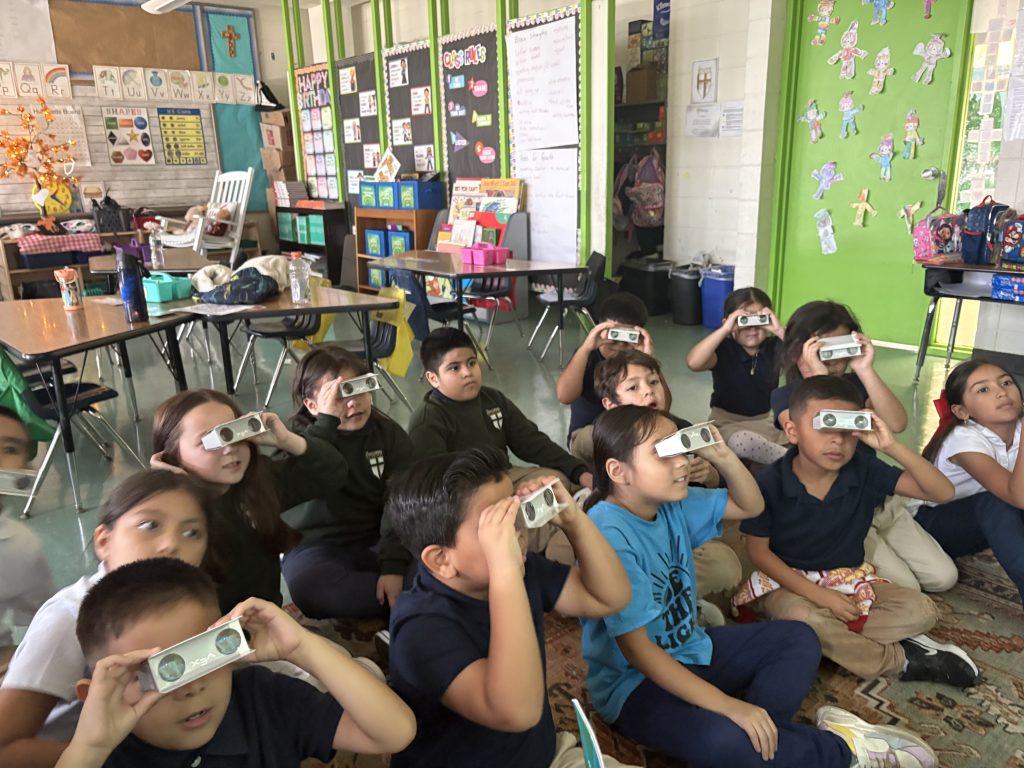
Introduce students to binoculars. Folding binoculars can be purchased from amazon.
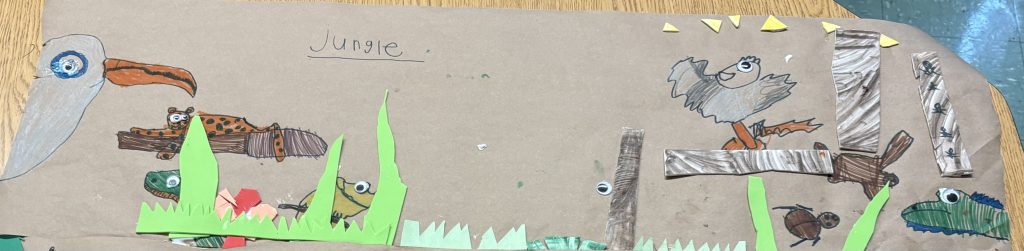
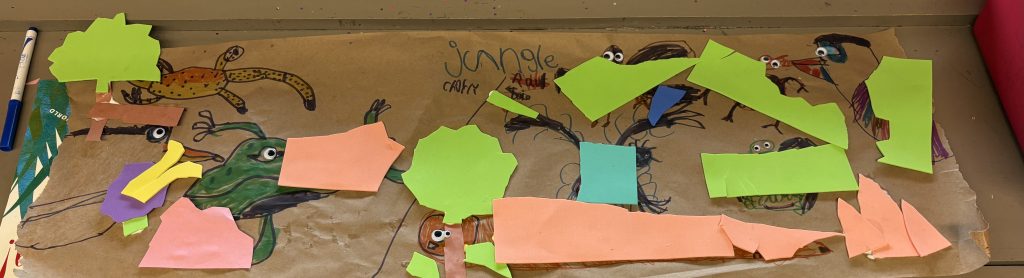
Introduce the vocabulary word camouflage. Use Robert Marzano’s 6 step to teaching vocabulary. Have students interact with the read aloud to show their knowledge of the word.
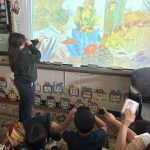
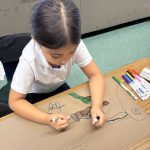
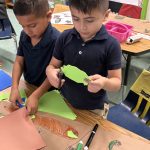
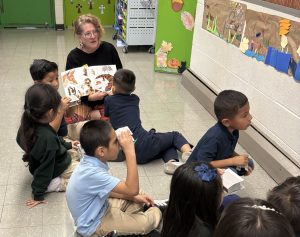
Follow up the camouflage activity with a teacher directed writing lesson from Read to be Ready and Bartlett City Schools.
I See a Kookaburra! Middle School
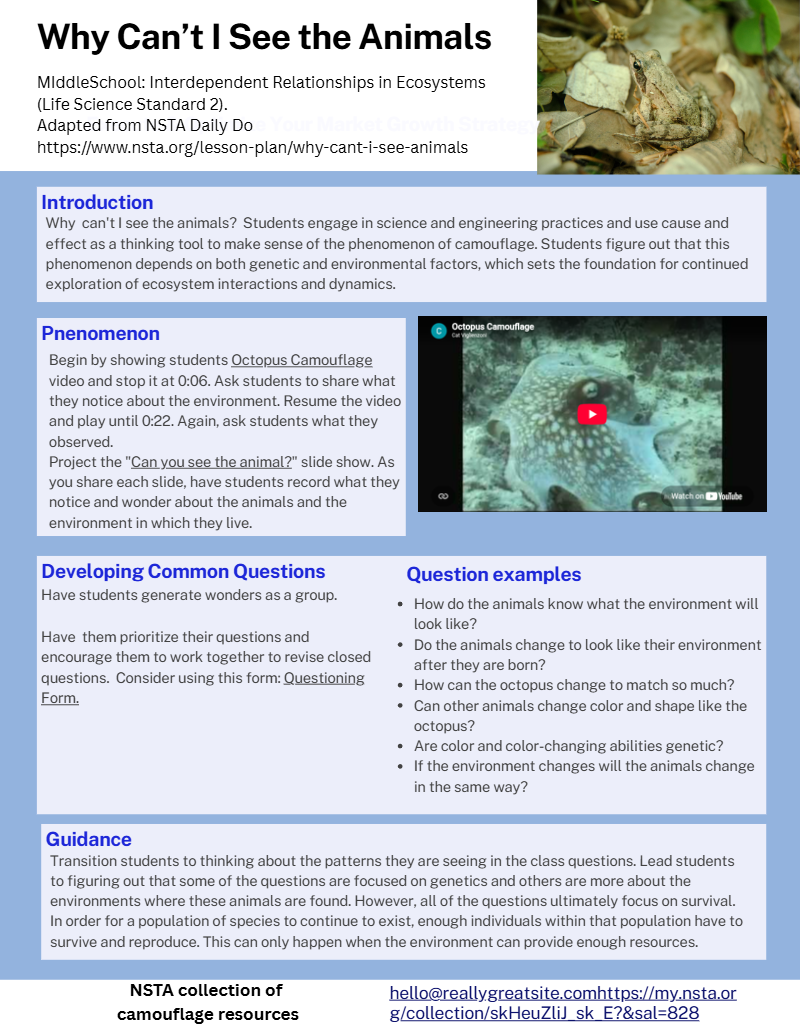
Play Read Aloud for students and complete lesson on Why Can’t I See Animals.
This lesson is great for teachers who need facts to guide student questioning.
Middle School: Interdependent Relationships in Ecosystems (Life Science Standard 2).
Adapted from NSTA Daily Do https://www.nsta.org/lesson-plan/why-cant-i-see-animals
Bees Are Our Friends by Tori D Alia
Bees Are Our Friends invites readers into a stunning garden to admire the hard work of one little bee. As the bee pollinates the garden, vibrant flowers and ripe fruit and vegetables burst to life around her. Down in the garden, up high in a tree, is a busy beehive … and one little bee. Written in irresistible rhyme by Toni D’Alia, and lavishly illustrated by Alice Lindstrom, young readers will pore over this perfect introduction to these essential insects.
Building A Dream by Darshana Khiani
In Thailand’s Phang Nga Bay, atop a network of stilts, floats the village of Koh Panyee―where a group of boys loved soccer but had nowhere to practice. Where could they find space to dribble, juggle, shoot, and score? The boys looked out at the water and started gathering tools.
Even while their neighbors laughed, they sawed wood, hammered nails, and tied barrels together. The team worked for weeks to build Koh Panyee’s first floating field―a place to practice, and a place to transform their community.
Community Building Activity for the Year
I have forever been using the video below as a community builder for my classroom, professional developments, and presentations.
I was thrilled to see the story written in a book, so I added it to my read aloud collection. You can order the book on Amazon.
Lesson Ideas:
- Have students work in groups to brainstorm actions, attributes, and words, from both the book and video, that complement a positive classroom community.
- Compare the book to the video.
- Research Koh Panyee, Thailand and compare their football with soccer in the states.
- Draw up designs for a Pitch in your school, neighborhood, or city park.
Lesson Ideas:
- Have students work in groups to brainstorm actions, attributes, and words, from both the book and video, that complement a positive classroom community.
- Compare the book to the video.
- Research Koh Panyee, Thailand and compare their football with soccer in the states.
- Draw up designs for a Pitch in your school, neighborhood, or city park.
- Interact with the steps of The Engineering Design Process
- Play the read aloud for the students and interact with the class by eliciting responses through questioning.
- Play the Panyee short film.
- Play the Engineering Design Process Video.
- Have students complete the formative assessment from the Science Spot.
- Have students work with a group or partner to find examples of the Boys of Panyee engaging in the engineering design process.
The World's Game by Yamile Saied Mendez
Soccer and the World Cup bring people from all over the world together. Witness the energy, passion, and glory of the world’s most popular sport, on and off the field. As one match happens in the stadium, one family gathers to watch the game at home. See the players leave it all on the field and the family watch enthusiastically on tv.
With bright, colorful art and lively dialogue, this uplifting and heartfelt story is a love letter to the sport, the fans, and the communities we make. Get ready to jump, holler, and cheer for “the beautiful game”!
Integrate a Science Lesson with your PE Teacher
The Magnus Effect
The Magnus effect is a phenomenon where a spinning object curves in the air. As the object spins, it drags air along with it on one side, making the air move faster. This creates a difference in air pressure, pushing the object toward the side with lower pressure and causing it to bend.
- In 1997, Roberto Carlos scored on a free kick, it was the perfect velocity, spin rate, and distance that curved the ball so dramatically the goalkeeper didn’t even move.
- Show students the video.
- Discuss what they notice about Roberto’s feet, the path of the ball in the beginning, near the goal, and in the goal.
- Show Noticing Nature With Tiny Lee: Magnus Effect.
- During the soccer unit in PE have the students practice seeing if they can curve the ball. Use these videos to help facilitate the lesson.
My Tiny Life by Ruby T Hummingbird
Tiny but mighty! A ruby throated hummingbird tells his own life story in this funny, bright, informative entry to the critically acclaimed Nature Diary science series.
May 15: Today I poked my way out of this tiny egg.
With Mom feeding him insects and nectar, Ruby T. Hummingbird is soon able to beat his wings and fly–up, down, backward, and forward–and forage for himself. But don’t be fooled! This elegant creature can turn into a fierce fighter if another hummingbird tries to feed on his flower–or his hummingbird feeder.
June 21: This flower is MINE! No you don’t.
Use the Read Aloud as a beginning of the year formative assessment focusing on details in drawings and writing.
- Play the read aloud and focus your interactions and questions on the diary styled dialogue of Ruby T.
- Use the Daily Note templates and have students casually write, and/or draw one thing they did, experienced, saw, learned from the day.
- This activity can be done at end of the day while packing up; thus allowing students to be at a task while others are busy. Since it is open ended and natural, direct instruction can be modified.
- Complete for the first few weeks of school.
- This can be saved for noticing growth at the end of the first quarter, or sent home for students to share their first few week experiences.
Resources:
- Article: Using Drawings for Formative Assessment
- Student Writing Prompts
- Go to link, make a copy, and edit for your own student needs.
- Hummingbird Sounds
Wonder Walkers by Micha Archer
A Caldecott Honor winner!
Micha Archer’s gorgeous, detailed collages give readers a fresh outlook on the splendors of nature.
When two curious kids embark on a “wonder walk,” they let their imaginations soar as they look at the world in a whole new light. They have thought-provoking questions for everything they see: Is the sun the world’s light bulb? Is dirt the world’s skin? Are rivers the earth’s veins? Is the wind the world breathing? I wonder . . . Young readers will wonder too, as they ponder these gorgeous pages and make all kinds of new connections. What a wonderful world indeed!
After showing and interacting with the Read Aloud, go on a Nature Walk and be a "Wonder Walker".
- Take students for a walk and have them elicit Wonder questions of what they notice.
- Have students walk quietly and Notice Nature.
- When they have a “Wonder”, have them hold up their hands in the shape of a W and share their “Wonder”.
- You may want to tell students that they will not be answering the questions today, just wondering.
- To accommodate all learners, use the terms to ignite “Wonders” before going for a walk.
- Article from Edutopia: Harnessing the Power of Inquiry.
Student Support

Patterns Patterns Everywhere by Kellie Menendez
From the ocean’s coral reefs to the jungle and even the dinner table, children learn to discover patterns big and small, hidden within vibrant illustrations and playful rhymes.
Foster a sense of wonder and creativity with Patterns, Patterns, Everywhere, a stunning picture book that invites young readers to explore the bold, beautiful patterns all around them. Identifying patterns is a key part of early childhood development, helping kids sharpen their reasoning and sequencing skills. This engaging book encourages children not only to find the patterns they can see, but also to think about patterns they can hear, feel, and create.
Patterns and Math
The Mathematics of Patterns and Algebra
Patterns are at the heart of mathematics. This article explains the basic math underlying the patterns that children encounter in their everyday lives and in preschool. Teachers need to understand these basic math concepts in order to help children build on their intuitive knowledge of them. One key concept is the generalization of patterns: the ability to apply a pattern (e.g., ABAB) to multiple materials and contexts. Other concepts covered include copying, extending, and creating patterns.
After interacting with the read aloud ask students,”What makes something a Pattern”?
Take students on a pattern walk. Have them draw any pattern they see, or have them find specific patterns in specific places.
Stickler Loves the World by Lane Smith
Stickler, an original character covered in sticks and with multiple ever-changing eyes, loves its little world. With best friend Crow, it shares the wonders of all the amazing things the world has to offer. Stickler is astonished by the ordinary, such as the sun and the stars, as well as fascinated by those things in nature that are often overlooked, such as swirling seed pods falling from the sky. The two pals wander about the world, stopping to appreciate the many marvels along the way, especially its beloved sticks, each one unique.
During or After the Read Aloud Activity
“If you think about it, our world has some pretty weird, amazing, and fantastic stuff in it…”.
After listening and thinking about all that Stickler loves in the world, add some ideas of your own.
The Seventh Father of the House by Peter Christen Asbjørnsen
A Norwegian Folktale by Peter Christen Asbjørnsen. First published in Norway during the 1840s as part of their famous collections of traditional folklore.
A tired traveler asks for a place to sleep at a large farm. An old man chopping wood tells him to ask his father, who tells him to ask his father, continuing down a chain of seven increasingly ancient fathers.
CCSS.ELA-Literacy.RL.2.2
Recount stories, including fables and folktales from diverse cultures, and determine their central message, lesson, or moral.
Play the Read Aloud for the students.
- Share with them information on Norway and that Norwegians have a strong focus on friluftsliv.
- Pronunciation: free-loofts-liv
- Meaning: open-air living.
- Discuss the moral of the story with the class.
- Wisdom is passed down from generation to generation.
- Tie this idea into class procedures.
- Ask students to interview their parents, grandparents, great grandparents on the class procedures that they want to share wisdom on.
- Possibly create your rules and procedures BB from these interviews.
- Discuss safety, ask students to share times when they think that this moral may not apply.
CCSS.ELA-Literacy.RL.3.2
Recount stories, including fables, folktales, and myths from diverse cultures; determine the central message, lesson, or moral and explain how it is conveyed through key details in the text.
Play the Read Aloud for the students.
- Share with them information on Norway and that Norwegians have a strong focus on friluftsliv.
- Pronunciation: free-loofts-liv
- Meaning: open-air living.
- Discuss the moral of the story with the class.
- Wisdom is passed down from generation to generation.
- Have a discussion on this.
- Is this always true?
- Can the meaning be lost in the listening and translation of the ideas passed on?
- How do you feel about the statement, “Older is wiser”.
- Have a discussion on this.
- Wisdom is passed down from generation to generation.
- Have students work in groups to create a story board that puts the Norwegian ideology of friluftsliv as a moral to a story.
- Have students act out the storyboard for the class.
- Have students work in groups to put the folktale into a book on https://storyjumper.com/.
- See if the students can draw the illustrations in art class. Take pictures of the illustrations and upload them into the sto
CCSS.ELA-Literacy.RL.5.7
Analyze how visual and multimedia elements contribute to the meaning, tone, or beauty of a text, including multimedia presentations of a folktale or myth.
Play the read aloud for students and have them
- analyze if, and how visual and multimedia elements contributed to the meaning, tone, or beauty of the text.
- find different adaptations of the folktale and compare and contrast the feeling of the folktale from the adaptation used in the read aloud.
- write reviews for the reader of the read aloud and offer advice for visual and multimedia elements. lmg@k8edconsulting.com.